Understanding the “Long Middle” of Burnout Recovery and Why it Can Feel so Confusing, Inconsistent, and Painfully Slow
There is a stage of burnout recovery that many parents find themselves living in, but very few people talk about clearly.
It is the space after the initial crisis.
The space where things may no longer feel quite as acute, catastrophic, or survival-based as they once did, but life still does not feel steady, sustainable, or settled again.
During this stage, your child may no longer be in complete shutdown. You may notice moments that feel more settled; you may be reconnecting in small ways. Or you may notice, as I like to call them, ‘green shoots of recovery’.
And yet one good day can still be followed by a huge crash. Connection can suddenly become withdrawal. Your child’s capacity can show a slight increase in what they can manage and then disappear. Small demands can still create overwhelm, and your whole family can still feel emotionally fragile.
Parents often describe this stage as feeling like they are running a marathon without a finish line.
Like they are holding the emotional middle ground for everyone else while quietly carrying their own exhaustion, grief, uncertainty, and hypervigilance.
This is the stage I often refer to as the “long middle” of burnout recovery.
And one of the biggest reasons this stage feels so confusing is that recovery does not move in a straight line.

Burnout Recovery is Not Linear
Many of us have been taught to think about healing as a linear process.
You rest.
You recover.
You improve.
You move forward.
But nervous systems and burnout recovery rarely work this way.
Especially with nervous systems that have been living under chronic stress, overwhelm, masking, pressure, trauma, sensory overload, or prolonged survival states.
Research into stress physiology, trauma, and nervous system regulation consistently shows that recovery is often nonlinear and adaptive rather than predictable.
Dr Stephen Porges’ Polyvagal Theory helps us understand that nervous systems are constantly responding to cues of safety and danger in the environment. Nervous systems do not simply “switch off” survival responses because someone wants to feel better. They reorganise slowly, relationally, and in response to experiences of safety over time.
This is part of why burnout recovery can feel so inconsistent.
The nervous system may begin cautiously testing expansion while still carrying deep survival conditioning underneath.
Kristy Forbes often speaks about burnout not as defiance or lack of motivation, but as a nervous system and body overwhelmed beyond capacity.
And when safety slowly begins returning, systems do not usually move neatly from “unwell” to “well.”
They wobble.
They test.
They retreat.
They reorganise.
They try again.
Rethinking Autistic Burnout Recovery Stages
One of the biggest shifts in my own understanding of burnout recovery came when I realised that this “long middle” is often not one stage.
It is multiple overlapping processes happening inside the family ecosystem at once.
Not a checklist.
Not a straight path.
Not neat phases families complete in order.
But three interconnected movements that systems often cycle through as safety slowly begins to return:
- Stabilising Safety
- Growing Edges
- Integration
Families often move in and out of these repeatedly.
A child may be exploring growing edges in one area while still needing deep stabilising safety in another.
A parent may be trying to integrate new ways of living while still carrying a nervous system shaped by chronic unpredictability and fear.
This is one of the reasons the long middle can feel like it goes on forever. Families are not moving through one neat process. They are often moving through multiple layers of healing simultaneously.
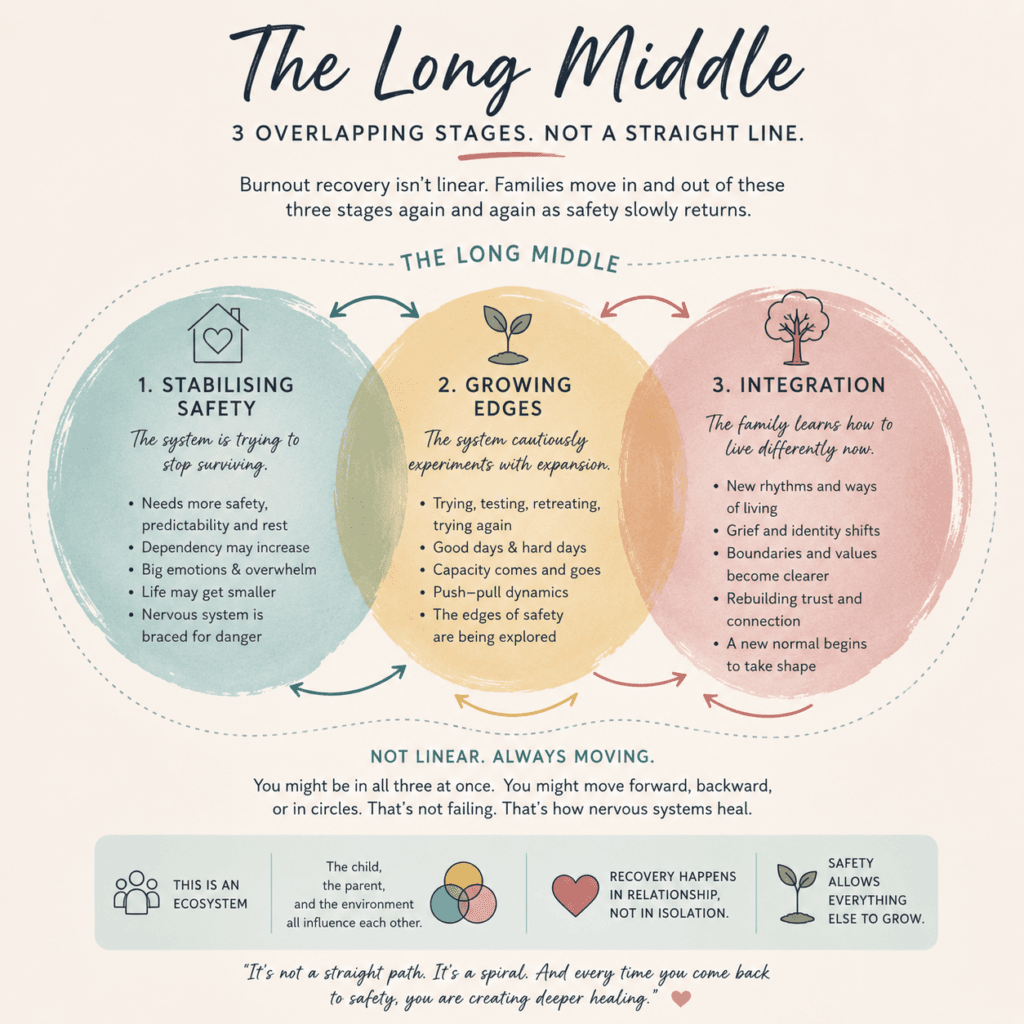
The Long Middle: A Relational Ecosystem Approach to Burnout Recovery – Tanya Valentin
Stage 1: Stabilising Safety
This is the stage where the nervous system is trying to stop surviving.
For children, this can look like:
- Increased dependency
- More withdrawal
- Lower tolerance for demands
- Bigger emotional reactions
- Sensory overwhelm
- Unpredictable sleep patterns
- Limited access to their basic needs
- Needing life to become smaller and more predictable
- More need for control
- Exhaustion
- Reduced executive and adaptive functioning
Many parents panic during this stage because externally it can look like:
“We are going backwards.”
But often, what is happening is that the nervous system is only just beginning to stop bracing long enough for deeper exhaustion, overwhelm, grief, or unmet needs to surface.
Amanda Diekman’s writing on low-demand parenting challenges the idea that reducing demands is “giving up” or permissive. Instead, her work reframes lowering demands as a proactive way of reducing nervous system overwhelm and increasing safety and capacity over time.
This stage often requires families to radically rethink cultural ideas around productivity, independence, resilience, and functioning. Because sometimes safety does not initially look like progress.
Sometimes it looks like collapse before steadiness.
What Happens for Parents During this Stage of Burnout Recovery?
Parents have nervous systems too.
This may seem obvious, but this is something our culture often fails to recognise.
Many parents in burnout recovery are themselves living in chronic states of hypervigilance.
Their bodies have often been shaped by unpredictability, crisis cycles, sleep deprivation, fear conditioning and the lack of safe supports that are responsive to their family’s needs, emotional buffering, caregiver burnout and trauma, chronic stress and isolation.
Even when things begin settling slightly, parents may still feel unable to trust calm.
Parents may feel constantly braced, emotionally exhausted, always on edge and unable to fully relax.
They may live in constant fear of setbacks, stuck in “waiting mode”, and as if they are carrying the whole family ecosystem emotionally. Many parents find themselves constantly scanning for danger and preparing to leap into action in response to the next hard moment.

This is why burnout recovery cannot only focus on the child. The parent nervous system matters too.
Stage 2: Growing Edges
This is often the most confusing stage of burnout recovery.
Because the nervous system begins cautiously testing expansion.
A child may:
• Want connection and resist it at the same time.
• Try something new and crash afterwards.
• Explore independence and then appear to regress.
• Re-engage socially and then withdraw.
• Have good days followed by hard days.
• Show moments of motivation that suddenly disappear.
This inconsistency can feel terrifying for parents, and this unpredictability carries its own invisible load.
But the truth is that nervous systems do not heal through constant forward movement.
They heal through testing, retreating, reorganising, and trying again.
This is particularly important to understand during adolescence, which is often a vulnerable time for burnout.
Teenage brains are already going through significant neurological restructuring. Research into adolescent development shows that the prefrontal cortex, responsible for planning, impulse control, emotional regulation, and executive functioning, is still developing well into early adulthood.
At the same time, emotional and threat-processing systems can become more reactive.
So for teenagers in burnout recovery, parents often see burnout physiology, adolescent neurological development, and nervous system recovery all interacting together.
What can look like “lack of motivation” is often a far more complex combination of overwhelm, nervous system protection, developmental change, and fluctuating capacity.

Why Growing Edges Feel So Wobbly
This is often the stage where hope and fear begin to exist side by side.
Parents start wanting to trust recovery while simultaneously bracing for collapse.
One good day can create enormous emotional pressure. Parents may think: “Maybe we’re finally turning a corner.” And when a crash follows, the emotional whiplash can feel devastating.
But wobbling does not automatically mean failure. Very often, it means the nervous system is still learning: “What feels safe now?”
Stage 3: Integration
Integration is the stage where families slowly begin learning:
How do we live differently now?
It is human nature and therefore easy to become focused on, “How do we get back to who we were before?”
But a more valuable question during this time is “How do we move forward more sustainably?”
This stage often involves grief, because burnout recovery frequently changes so many things in our lives. Our children, us as parents, our family systems and the way we move through the world.
Many of the families I work with begin recognising that the old ways of living were not sustainable for the nervous system.
And this realisation can bring profound identity shifts and the need for new boundaries. Our values shift as do our priorities.
Many families find themselves redefining their relationship with productivity, capitalism and the ways that we view independence. They may find themselves needing to live at a slower pace that aligns with the nervous system of their child, or needing more support than they may have expected.
There is often grief here, too. Grief for what was, for how hard things became and for expectations that no longer fit as well as the invisible losses families carry.
Francis Weller’s work on grief reminds us that grief is not simply about death. It is also about unmet expectations, identity shifts, and the losses that accompany major life transitions.
And yet alongside this grief, there can also be deep love, tenderness, sacredness, and reconnection.
Healing is not always returning. Sometimes it is rebuilding differently.
Burnout Recovery Happens Inside an Ecosystem
One of the most important things I hope to teach parents, through understanding the “long middle”, and the work I do with families inside my community, From Burnout to Balance, is that burnout recovery is not just happening inside one child.

It is happening inside a family ecosystem. This includes the child, the parent and the environment.
As Urie Bronfenbrenner illustrated in his Ecological Systems Theory, all these systems are constantly influencing each other.
This is why recovery can feel so complex.
Because even when a child begins feeling safer, the parent may still be hypervigilant. School systems may still feel unsafe. Financial stress may still exist. Family misunderstanding may still be present, and cultural pressure may still be pushing toward productivity and independence.
New Zealand academic and psychiatrist Dr Mason Durie, through his Māori health framework, Te Whare Tapa Whā, reminds us that wellbeing is holistic and interconnected. In his collectivist model, different dimensions of well-being overlap and influence one another, rather than functioning separately.
This interconnected understanding aligns strongly with what many families experience during burnout recovery.
Recovery is relational.
Nervous systems heal in relationship.
And families often need support, flexibility, accommodation, community, and reduced pressure before authentic capacity can begin re-emerging.
The Cultural Problem Beneath “The Long Middle” of Burnout Recovery
Part of why this stage feels so frightening is that our Western culture idealises independence, productivity, and functioning.
So when a child needs more support, stops coping in expected ways, cannot tolerate demands, becomes more dependent or withdraws from life, many parents understandably interpret this as danger.
But dependency is not always regression.
Many nervous systems need deep co-regulation, accommodation, rest, flexibility, and interdependence before autonomy can emerge sustainably.
This directly challenges the cultural myth that healthy equals independent.
Instead, burnout recovery often teaches us something very different: healthy systems are connected, responsive, adaptive, and relational.
If You Are In The “Long Middle” of Burnout Recovery Right Now
I hope this helps you understand that what you are living through may make more sense than you realise.
The inconsistency.
The wobbling.
The unpredictability.
The emotional exhaustion.
The grief.
The fear.
The slowness.
Very often, these are part of what nervous systems look like as they slowly reorganise around safety.
And this takes time.
Not because you are doing it wrong or because your child is failing.
Not because your family is broken.
But because nervous systems move at the speed of safety, not pressure.
If you are walking this long middle right now, I hope you know this, too: you were never meant to carry this level of emotional weight alone. You deserve support, understanding, and steadiness, too.
How You Can Be Supported in This Autistic Burnout Recovery Stage
In my upcoming workshop: Why is My Child’s Burnout Recovery Taking So Long? Understanding and Navigating the Long Middle of Burnout Recovery
Together we’ll explore:
- Why burnout recovery is so rarely a straight line, and why recovery often takes so long
- The three stages of the long middle of burnout recovery, and how to locate where your family is right now
- One gentle shift you can begin making this week
This is a space for parents looking for deeper understanding, validation, and support as they navigate this stage of recovery.
Find out more here
References
Reber, D. (2023). Differently Wired: A Parent’s Guide to Raising an Atypical Child with Confidence and Hope. Workman Publishing.
Siegel, D. J. (2020). The Developing Mind: How Relationships and the Brain Interact to Shape Who We Are (3rd ed.). Guilford Press.
van der Kolk, B. (2014). The Body Keeps the Score: Brain, Mind, and Body in the Healing of Trauma. Viking. Weller, F. (2015).
The Wild Edge of Sorrow: Rituals of Renewal and the Sacred Work of Grief. North Atlantic Books.
Porges, S. W. (2011). The Polyvagal Theory: Neurophysiological Foundations of Emotions, Attachment, Communication, and Self-Regulation. W. W. Norton & Company.
Delahooke, M. (2022). Brain-Body Parenting: How to Stop Managing Behavior and Start Raising Joyful, Resilient Kids. Harper Wave.
Diekman, A. (2023). Low-Demand Parenting: Dropping Demands, Restoring Calm, and Finding Connection with Your Uniquely Wired Child. Jessica Kingsley Publishers.
Durie, M. (1985). Te Whare Tapa Whā: A Māori Model of Health.
https://www.health.govt.nz/maori-health/maori-health-models/te-whare-tapa-wha
Bronfenbrenner, U. (1979). The Ecology of Human Development: Experiments by Nature and Design. Harvard University Press.
Forbes, K. “When Burnout Looks Like Breaking.” https://www.kristyforbes.com.au/blog/Whenburnoutlookslikebreaking
The Person Who Wrote This Blog

Tanya Valentin is a neuro-affirming family coach, writer, and community leader supporting parents of neurodivergent children through burnout recovery.
Drawing on lived experience, nervous-system-informed practice, and relational facilitation, her work explores grief, identity, and the quiet return to self-trust.
She is the founder of the supportive community who are parenting neurodivergent children and teens in burnout, From Burnout to Balance and the author of Tiny Anchors: Small Moments of Care for Parents in Burnout
Have you enjoyed reading this blog? Subscribe and receive fresh reflections, parenting resources and validation every time I push publish.

2 Comments on Why Autistic Burnout Recovery Takes So Long