Unpacking the Family Ecosystem Approach to Burnout Recovery, and Why it Changes Everything About How we Support Neurodivergent Families
I used to think burnout recovery was something that happened inside my child.
That if I found the right support, the right adjustments, the right words, something in her would shift, and the rest of us would simply return to how things were before.
I do not think that anymore.
What I have come to learn, through years of living this and through everything I have studied before and since, is that recovery does not happen within a child alone.
It happens within a relationship. Within a family. Within what I like to call the Family Ecosystem Approach.
Because the truth is, my child’s burnout did not happen in isolation. Long before she went into burnout, there were signs within our family that something wasn’t right.
Her burnout did not just happen to her. And it took considerable time, work, change and healing within our whole family for her to recover.

Why an Ecosystem, and Not a Checklist?
When your child goes into autistic or neurodivergent burnout, it is tempting to look for the fix.
The right strategy, the right diagnosis, the right professional who finally understands.
I looked for all of these things too, and some of them helped, in their own limited way. But none of them explained why I was falling apart at the same time my child was.
None of them accounted for the fact that my own nervous system, my own history, my own capacity to stay regulated, was shaping what was possible for my child just as much as anything happening inside her.
That is the piece almost nobody names.
Your family is not a collection of individuals, each with their own separate problem to solve. It is a living, interconnected ecosystem.
Every person in it- your child, you, your other children, your child’s co-parents, your environment- all of it influences everything else.
Change one part, and the whole system feels it.
This is the foundation the Family Ecosystem Approach stands on.
Three systems, always at play.
The Three Systems Inside of The Family Ecosystem Approach
Inside every family navigating burnout recovery, three systems are always in motion together.
The Child System.
This encompasses everything unique to the child in front of you, their neurobiology, sensory profile, co-occurring conditions, temperament, and personal history.
Dr Emmi Pikler’s work has shaped how I understand children, and how I try to show up in my own relationships. She believed children carry an innate blueprint for their own development, one that unfurls in its own time when the conditions are right. She encouraged caregivers not to rush an infant toward the next milestone, but to trust their capacity to discover it themselves, in their own time, at their own pace. Pikler, E. (1971). Learning of motor skills on the basis of self-induced movements. In J. Hellmuth (Ed.), Exceptional infant: Vol. 2. Studies in abnormalities (pp. 54–89). Brunner/Mazel.
Children need safety to explore. Space to learn about their own capacity, their own identity, how the world feels to them now.
The Parent System.
And here is something worth sitting with.
A parent’s nervous system was never separate from their child’s. Our nervous systems stay in constant communication with the nervous systems around us, through mechanisms like mirror neurons, through simple proximity, through years of attunement.
Sir Mason Durie’s Te Whare Tapa Whā (Durie, M. (1984). Te Whare Tapa Whā: A Māori model of health. In Proceedings of the Māori Health Planning Workshop. Department of Health, Wellington, New Zealand) reflects this too. Individual health cannot be separated from family health. One does not exist without the other.
Parents have their own neurobiology, their own sensory profile, their own co-occurring conditions, temperament, and personal history too.
Parents need space to heal. Support and co-regulation to grow their own capacity. Time and room to process their own trauma, ancestral cycles and grief, while learning to hold connection with our children without losing ourselves inside it.
The Environmental System.
This is the physical world around a family, but it is also the emotional, cultural and systemic environments they move through.
Urie Bronfenbrenner’s Ecological Systems Theory (Bronfenbrenner, U. (1979). The ecology of human development: Experiments by nature and design. Harvard University Press) names this clearly. A child and their family do not exist in isolation from the world around them. The relationships, systems and policies outside a family shape what happens inside it, just as much as what happens inside a family ripples outward.
Autistic people do not outgrow their risk of burnout. This is something we will always have to manage. Recovery depends hugely on whether the world feels safe enough to re-enter, on the demand, the pressure, the lack of understanding that so often keeps a whole system in survival mode.
None of these three systems moves in isolation. When your child’s world becomes overwhelming, your nervous system feels it. When your nervous system is depleted, your capacity to hold your child changes. When the environment presses in with expectation and judgment, both of you feel the weight of it.
This is not a flaw in your family. It is how living systems work.
Change one part, and you change the whole ecosystem.
This is why fixing your child was never the goal. Children heal in relationship with people, places and things. Your nervous system and your environment were always part of the story too.
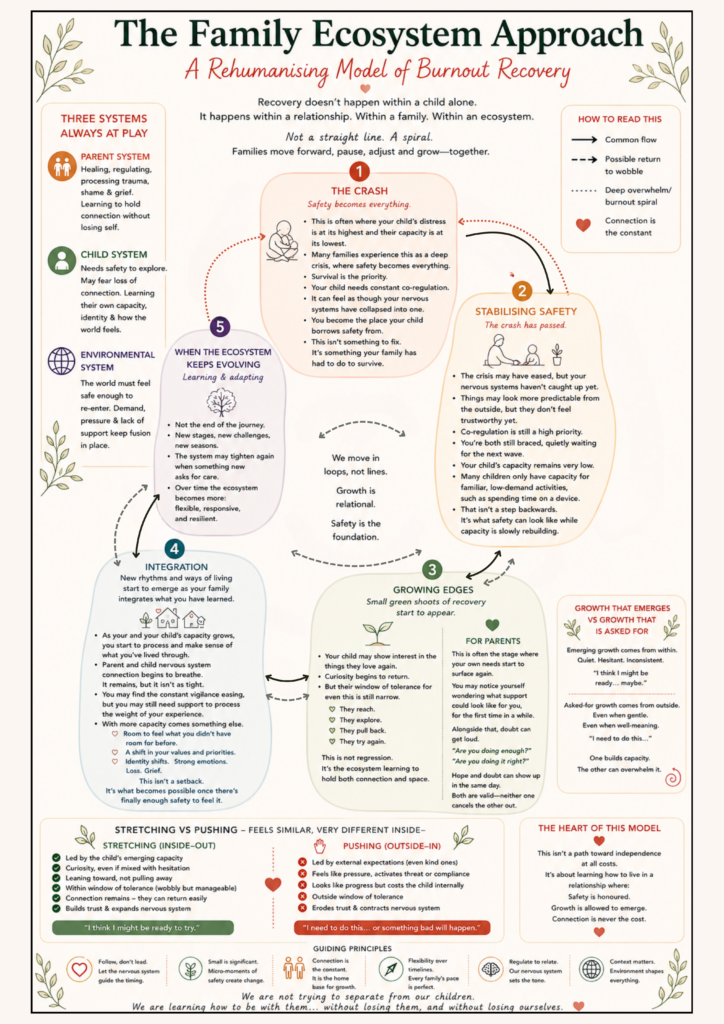
The Stages Within The Family Ecosystem Approach
The version of recovery most of us were handed looks like a staircase.
Crisis, then steady improvement, then arrival. Each step slightly better than the last, moving in one direction, toward a finish line.
That is not what I lived. And it is not what the families I work with live either.
What actually happens looks more like a spiral. A family moves through several relational movements, not once, but again and again, each time with a little more capacity than before.
It often begins with the crash. Acute burnout. The stage where your child’s distress is highest, and their capacity is lowest. Families often experience this as a deep crisis that turns your whole world upside down and feels as though your nervous system and your child’s collapse into one.
Then comes stabilising safety. This is the first part of the long middle of burnout recovery.
The crash has passed, but your nervous systems have not caught up yet.
Things look more predictable from the outside, but there is a precarious quality to it. The shift we might be feeling does not feel trustworthy yet, not to you and not to your child. You are both still braced, waiting for the next wave.
Then growing edges. Small green shoots of recovery start to appear, followed by crashes, retreat, and trying again. Your child’s capacity and window of tolerance, even for the things they love or are curious about, is still narrow.
This is often where your own needs start to surface again too, for the first time in a while. You may start considering what the future might look like, which can feel both hopeful and terrifying. Alongside that, doubt can get very loud.
This is also when many parents begin to consider what support they or their family might need. Hope, doubt, grief, and possibility can all move through you in the same day. That is not a contradiction. That is growing edges.
Integration. New rhythms and ways of knowing, doing and being begin to emerge. During this time we may start to feel as if we have the capacity to process our experiences. This can highlight familial cycles that need to be broken, a shift in values and priorities as well as identity shifts and deep grief.
The nervous system connection between the child and parent begins to breathe.
The connection and relationship remains, but it is not as tight. The constant vigilance many children and parents feel starts to ease, even while you may still need support to process the weight of what you have lived through.
This evolves into learning and adapting. This is not the end of the journey, as burnout remains a reality for many autistic and neuro complex humans. As our child grows and develops and our family shifts and changes, new seasons will ask for care again, and that is not failure either.
And sometimes, when stress exceeds capacity for too long, the whole system tightens back into the crash.
That is not failure. It is a signal. A sign that support is needed, not evidence that something has gone wrong.
As humans, we move in loops, not lines. Growth is relational, and safety is the foundation everything else grows from.
What This Series Will Hold
This is a first in a series of articles outlining the Family Ecosystem Approach to burnout recovery.
Over the coming weeks, I want to walk through this approach with you properly.
Not as a set of techniques to apply, but as a way of seeing your family that might genuinely shift something.
We will spend time with each of the five stages in the spiral, starting with the stage most of us know by a different name entirely. The crash.
What they feel like from the inside, what they are asking of you, and what they are quietly building even when it does not look like progress.
We will sit with the difference between a child stretching from their own readiness and a child pushed by outside expectation, a distinction that changes everything about how you respond in the hard moments.
We will talk honestly about the grief that lives inside this work, the life you imagined, the parent you thought you would be, and why that grief deserves to be witnessed rather than rushed through.
And underneath all of it, we will keep returning to the same question. Not “what is wrong with your child?”, but “what does your whole ecosystem need in order to heal?”
Where to Begin?
If any of this is landing for you, you are not alone, and you are not doing this wrong.
You are living inside something that has a name, even if almost nobody has given you the map for it before now.
This is the Family Ecosystem Approach.
Not a path toward independence at all costs but a way of learning how to live in relationship, where safety is honoured, growth is allowed to emerge, and connection is never the cost.
Because the truth is that we are not trying to separate from our children. We are learning how to be with them, without losing them, and without losing ourselves.
More soon.
Tanya
About The Author
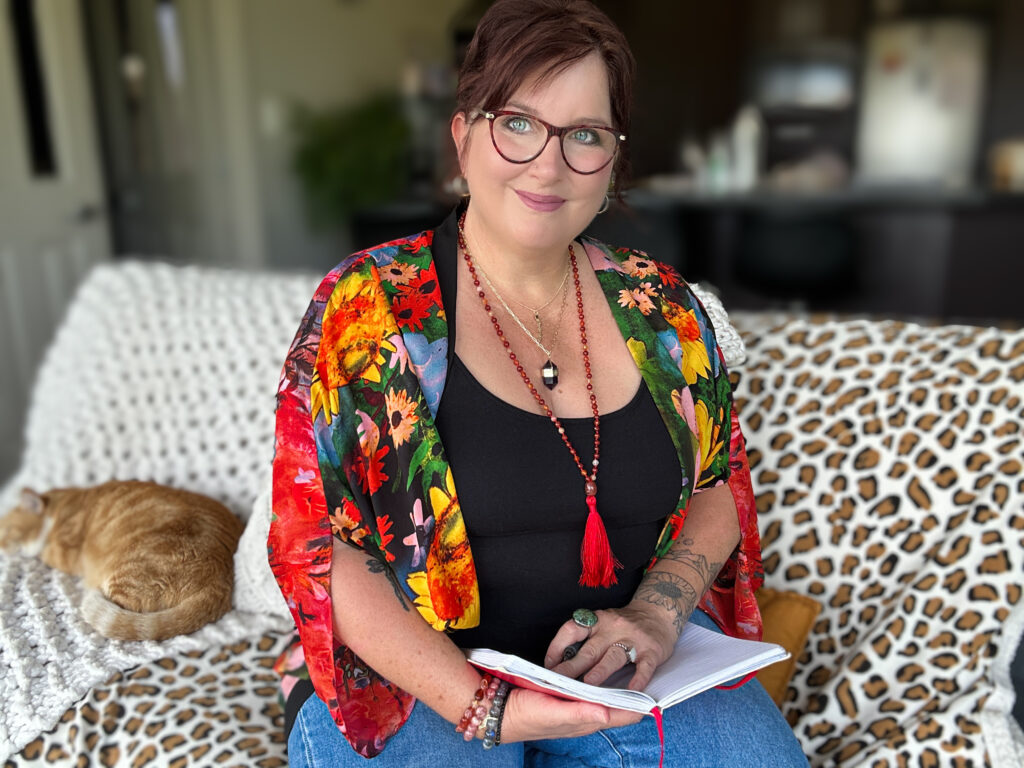
Tanya Valentin is a neuro-affirming family coach, AuDHD parent, author, and podcaster based in Aotearoa, New Zealand. She supports parents of Autistic, ADHD, and PDA children through the long middle of burnout recovery.
Drawing on lived experience and trauma-informed practice, her work explores grief, identity, nervous system recovery, and the quiet return to self-trust.
She is the founder of From Burnout to Balance, a membership community for parents navigating neurodivergent family life, and the author of Tiny Anchors: Small Moments of Care for Parents in Burnout.

2 Comments on Understanding Autistic Burnout Recovery: The Family Ecosystem Approach